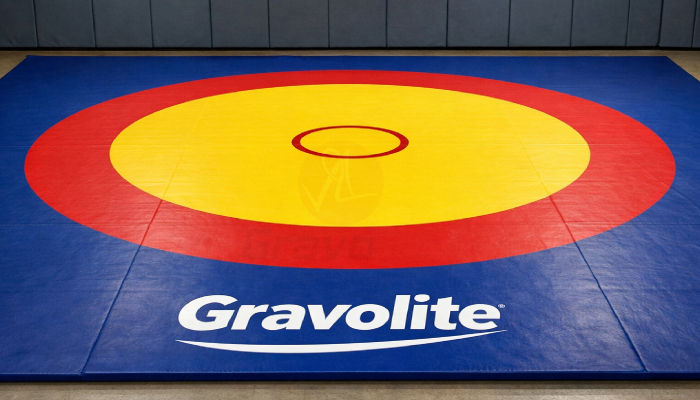
Wrestling Mat – Training, Kushti & Tournament Mats

A wrestling mat is more than just a floor covering. Every takedown, throw, roll, and ground drill depends on having a stable, impact-absorbing, and wrestling-specific surface. Whether you are setting up a wrestling academy, school, college, gym, akhada, or professional training facility, choosing the right wrestling mat can directly influence training quality, athlete comfort, and the overall safety of the practice area.

Gravolite offers Wrestling flooring solutions for training facilities, academies, and competition environments, along with supporting equipment such as wrestling dummies, crash mats, wall pads, and wrestling accessories.
If you are planning a new wrestling facility or replacing an existing mat, the right choice starts with understanding wrestling mat size, dimensions, thickness, application, and price.
What Is a Wrestling Mat?
A wrestling mat is a specialised sports surface designed for wrestling practice and competition. Unlike ordinary gym flooring, wrestling mats are engineered around the movements involved in wrestling, including takedowns, throws, falls, pins and ground-based techniques.
A suitable mat should provide a balance of impact absorption, surface stability, grip, durability and ease of maintenance.
For an academy, the ideal mat may be different from a tournament mat. Daily training facilities often prioritise durability and practical sizing, while competition installations may need specific dimensions, markings and performance specifications.
Wrestling Mat Size, Dimensions & Measurements
One of the first questions buyers ask is: What size wrestling mat do I need?
The answer depends on the application, available floor space, and whether the mat is intended for training or competition.
Training facilities can use different configurations according to their available space. For example, Gravolite offers wrestling training mat configurations in sizes such as 4 × 4 m, 6 × 6 m, 8 × 8 m, 10 × 10 m, and 12 × 12 m.
For a professional or tournament setup, the overall wrestling area should be planned according to the applicable competition requirements.
Before ordering, measure:
Available floor length and width
Columns, doors, and other obstructions
Required clearance around the wrestling area
Number of training zones
Storage and installation requirements
Wrestling Mat Price: What Determines the Cost?
There isn't one fixed wrestling mat price because different installations have different requirements.
The final cost can depend on:
Mat size
Thickness
Foam construction and density
Cover material
Number of panels
Competition markings
Customisation
Quantity ordered
Transportation
Installation requirements
A small academy training setup and a complete tournament installation can therefore have significantly different budgets.
Instead of choosing a mat only by the lowest price, consider its intended usage, expected training frequency, durability, and long-term value.
Training Wrestling Mat vs Tournament Mat
Wrestling Training Mat
A training mat is designed for regular practice in academies, schools, colleges, and sports facilities. The focus is generally on durability, impact absorption, easy maintenance, and practical installation.
A modular training configuration can also make it easier to adapt the wrestling area to the available floor space.
Wrestling Tournament Mat
Tournament mats are intended for organised competitions and events where dimensions, markings and performance requirements become particularly important.
For competition facilities, buyers should verify the applicable federation or event specifications before placing an order.
What Is a Kushti Mat?
Kushti mat is a commonly searched term for wrestling surfaces used for traditional Indian wrestling and modern Kushti training environments.
An akhada-style training environment can have different requirements from a conventional wrestling academy. The available space, training methods, surface preference, and expected usage should all be considered before selecting the mat.
If you are looking for an Indian Kushti mat or Kushti mat price, discuss your application and required dimensions with the manufacturer rather than selecting a generic mat based only on size.
Complete Wrestling Ground Setup
A professional wrestling area often needs more than a mat.
Depending on the facility, your setup may include:
Wrestling Mat: The primary training and competition surface.
Wrestling Dummy: Useful for practising takedowns, throws, grappling movements, and repetitive drills.
Crash Mats: Designed for high-impact landing and throwing drills.
Wall Pads: Help provide additional protection around walls and other hard surfaces in training areas.
Wrestling Shoes: Designed specifically for movement and grip on wrestling surfaces.
Wrestling Singlets: Competition and training apparel designed for freedom of movement.
Plyo Box: Useful as part of strength and conditioning programmes for developing explosive movement and lower-body power.
This allows academies to source multiple components of their wrestling training environment from a single sports-equipment partner.
Why Choose Gravolite for Wrestling Mats?
When investing in sports flooring, the manufacturer's experience matters.
Gravolite was established in 1970 and has more than five decades of experience in sports flooring and sports surfaces. The company is headquartered in Delhi and operates as a third-generation family business, serving customers in India and international markets.
Its wrestling range covers applications including training mats, tournament mats, approved mats, and supporting wrestling equipment.
For academies, institutions, and project buyers, this means the requirement can be evaluated based on the actual application rather than simply selling a standard-size mat.
How to Choose the Right Wrestling Mat
Before placing an order, consider these five questions:
Where will the mat be installed? Academy, school, gym, akhada, or tournament venue?
What is the available floor area?
Will it be used for daily training or competitions?
What thickness and construction are appropriate for the application?
Do you need additional equipment such as crash mats, dummies, or wall pads?
Answering these questions first can help you avoid ordering the wrong configuration.